Detect if a voice is human or AI in real time
Identify AI-generated speech, deepfake voice, and impersonation during live phone calls and voice-based workflows.
Voxmind enables organisations to detect if a voice is human or AI by analysing speech patterns and structural characteristics in call centers, banking systems, and telecom platforms.
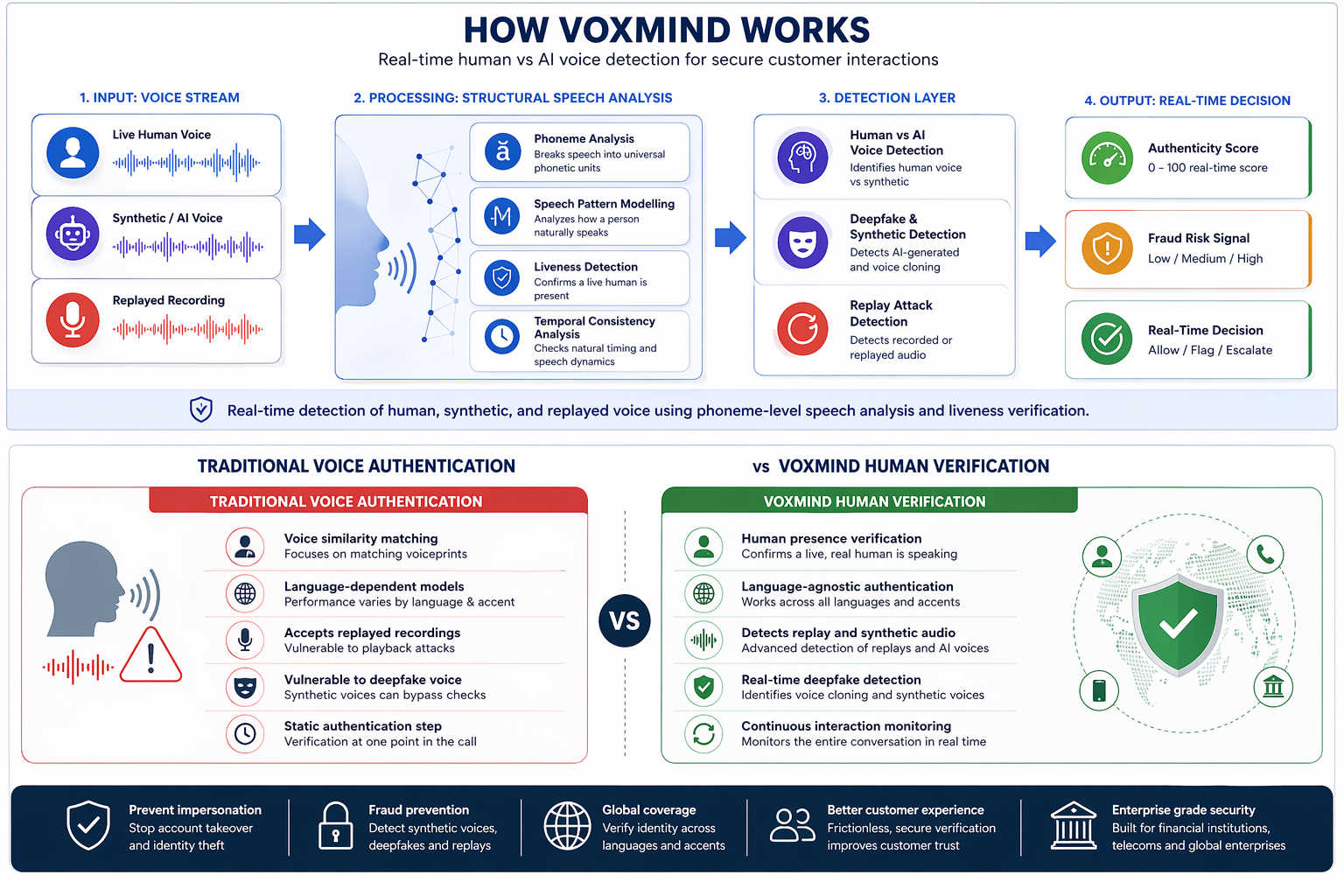
AI-generated speech is changing voice security
Modern text-to-speech systems can produce synthetic speech that closely replicates human voices across a wide range of contexts.
The challenge is no longer recognising a voice or matching identity. The challenge is determining whether that voice originates from a real human speaker.
- 01Synthetic speech can replicate tone and cadence
- 02AI voices can adapt dynamically within live phone calls
- 03Generated audio can remain consistent across different scenarios
- 04Traditional sample matching faces increasing limitations
Live systems need more than audio similarity
Human vs synthetic voice detection distinguishes genuine human voices from AI-generated audio within live interactions.
Structural speech analysis
Analyse how speech is produced instead of relying only on surface-level voice sound.
Real-time detection
Evaluate speech during active calls where decisions must be made during the interaction itself.
Synthetic speech patterns
Identify uniform timing, unnatural transitions, and structural artefacts in generated audio.
Multiple layers of speech production analysis
Voxmind evaluates timing, articulation, transitions, and consistency to identify patterns associated with human voices and AI-generated outputs.
Analyse audio at the structural level
Break speech into phoneme-level components and evaluate timing, articulation, and transitions.
Real-time AI voice detection
Evaluate speech during active phone calls and detect AI voice as the interaction happens.
Identify synthetic speech patterns
Detect uniform timing, consistent articulation, and artefacts between phonemes.
Continuous model evolution
Maintain detection capability as AI-generated speech systems improve over time.
Detect AI voice in call centers and enterprise systems
Voice-based fraud increasingly targets enterprise environments where human verification is critical.
Customer support operations
Detect deepfake voice and synthetic speech during real customer conversations.
Financial service platforms
Strengthen fraud prevention where voice is used to authorise actions or enable access.
Phone authentication
Differentiate AI voice from real voice during authentication and account recovery flows.
Global enterprise operations
Analyse live audio streams across diverse devices, networks, languages, and accents.
Human voice verification methods for modern systems
Traditional verification focuses on comparing a voice sample to stored audio. Voxmind evaluates how speech is produced.
This provides a stronger method for confirming whether a voice belongs to a real human speaker.
Beyond stored samples
Evaluate timing, articulation, and structural patterns rather than matching sound alone.
Real human speaker signal
Support high-confidence decisions where voice is used for identity, access, or authorisation.
Fake voice detection
Detect AI-generated speech, deepfake voice, and synthetic audio during live workflows.
Real-world audio conditions
Operate across background noise, variable quality, accents, languages, and dynamic calls.
Differentiate AI voice from real voice
Voxmind provides a more reliable way to determine whether speech originates from a real human speaker.

Improve the ability to detect if a voice is human or AI
AI-generated speech enables impersonation and fraud in voice-based systems. Real-time detection supports fraud prevention and human verification.
Detect synthetic voice before it impacts your operations
See how Voxmind verifies human presence and distinguishes AI-generated speech from real human voices in live enterprise systems.
Human vs AI voice detection
How can you tell if a voice is AI generated?
Systems analyse speech patterns, timing, and structural characteristics that differ between synthetic and human voices.
How do you detect AI voice in real time calls?
AI voice detection analyses audio during live interactions, evaluating phoneme structure, timing patterns, and consistency.
What is human vs synthetic voice detection?
It is the process of distinguishing real human voices from AI-generated speech by analysing how speech is produced.
Can AI voice detection work with background noise?
Yes. Advanced systems are designed to analyse audio in real-world conditions, including background noise and varying audio quality.
What tools are used to detect fake voice?
Enterprise tools analyse audio samples, clips, and live interactions, with a focus on real-time detection in operational environments.
Why is detecting AI-generated speech important?
AI-generated speech enables impersonation and fraud. Detecting it helps ensure interactions involve real human speakers.