Azure Speaker Recognition is retired. Voxmind is the advanced voice verification successor for Azure voice environments.
Microsoft retired Speaker Recognition in Azure AI Speech on September 30, 2025. Applications can no longer use the speaker-recognition APIs. Voxmind provides live human verification and real-time fraud detection for Azure-based customer service, account access and identity-sensitive voice workflows.
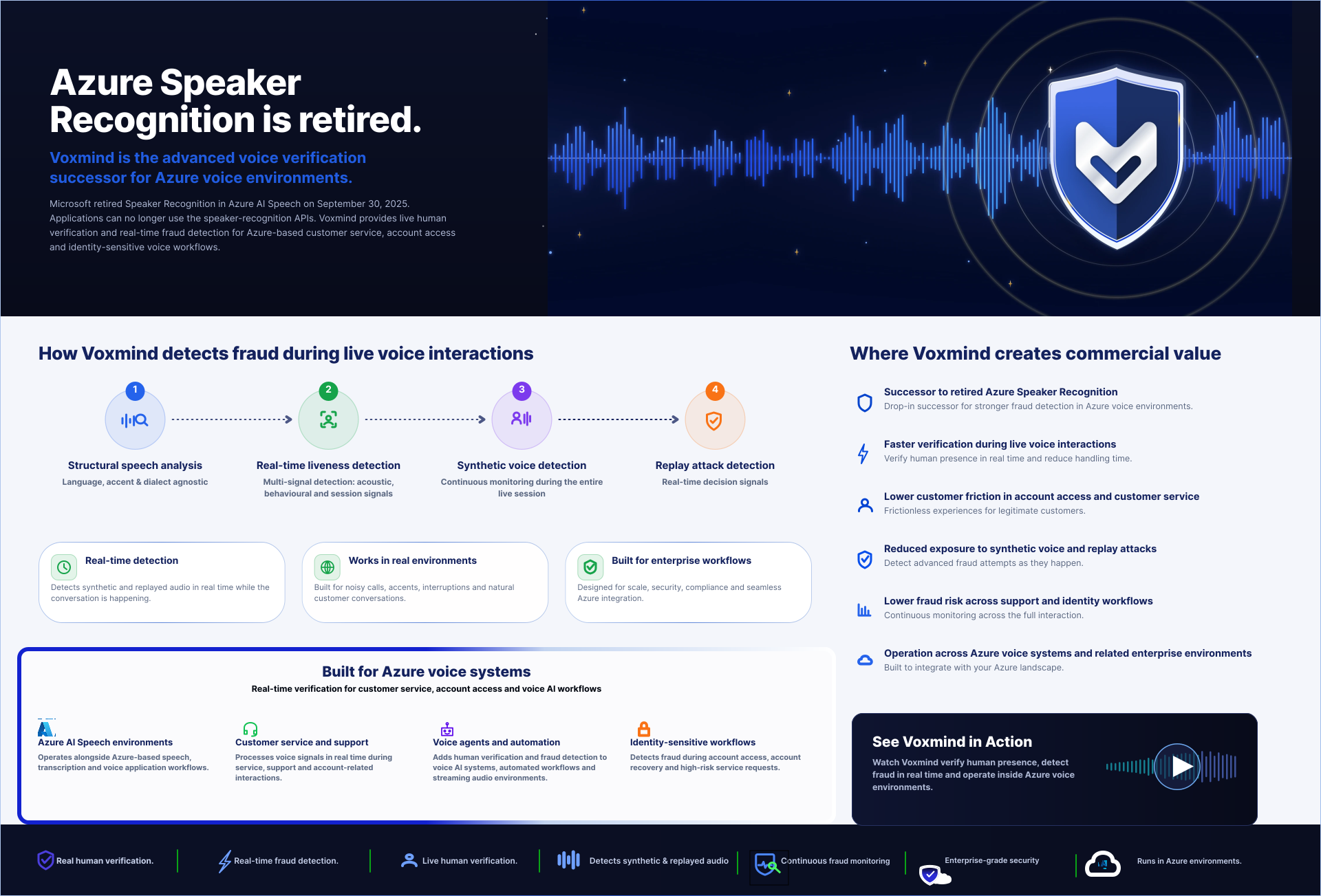
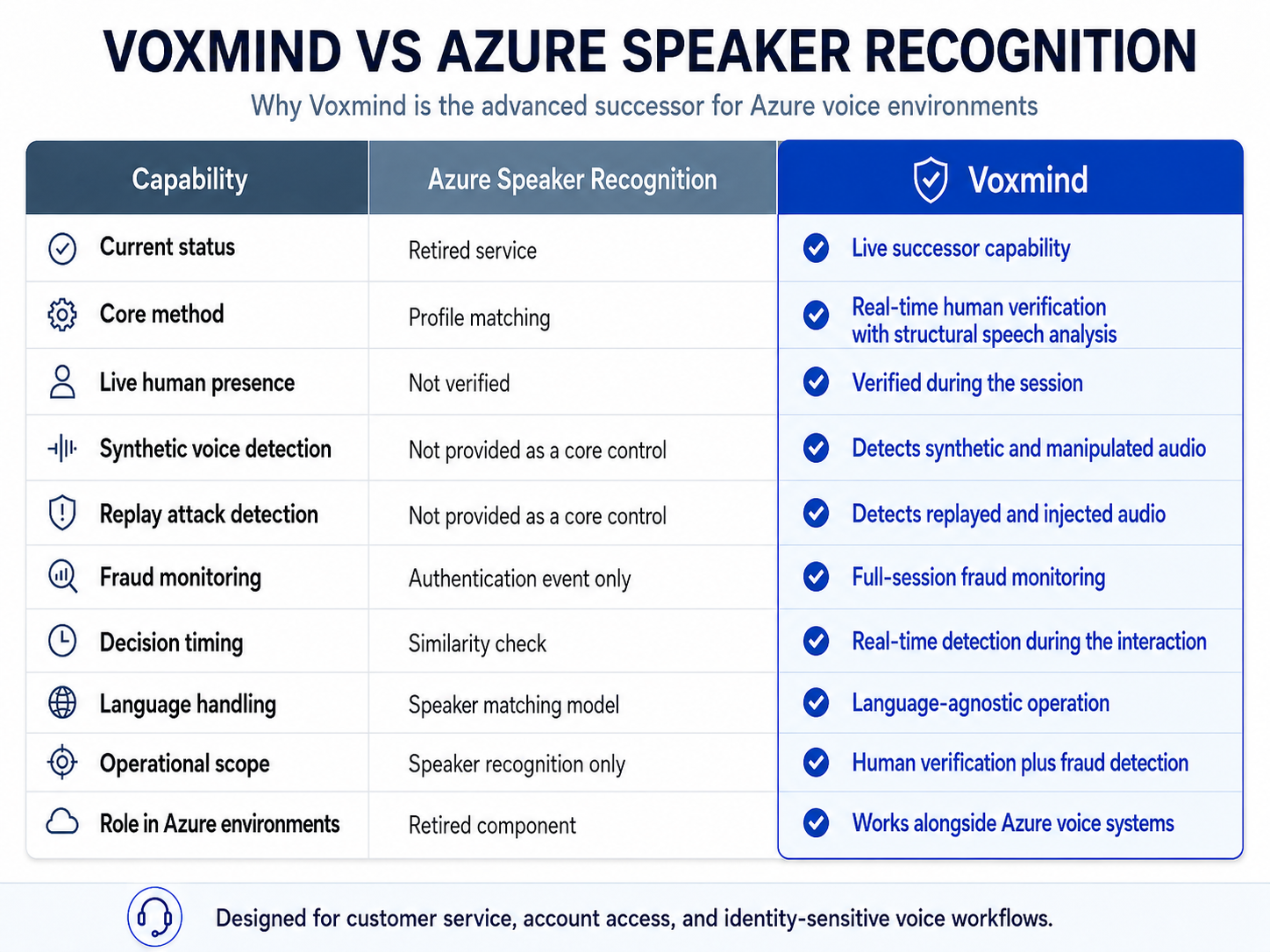
Voxmind verifies whether the speaker is human and live to detect attempted fraud. Azure compared voices.
Azure Speaker Recognition relied on profile matching. A voice could match a stored profile while being synthetic, replayed or manipulated. Voxmind goes beyond similarity checks: it verifies human presence during the session, detects synthetic and replayed audio in real time and monitors fraud signals across the full interaction irrespective of language.
How Voxmind detects fraud during live voice interactions
Structural speech analysis
Analyses phoneme-level articulation, timing, sequencing and speech pattern consistency.
Real-time liveness detection
Evaluates responsiveness, continuity and interaction consistency across the full session.
Synthetic voice detection
Detects AI-generated, manipulated and deepfake audio during live voice interactions.
Replay attack detection
Identifies recorded or injected audio used to imitate a live speaker.
Language-agnostic operation
Operates across languages, dialects and accents without per-language models.
Multi-signal detection
Evaluates human presence, synthetic voice indicators, replay characteristics and behavioural consistency together.
Continuous monitoring
Operates across pre-authentication, live interaction and post-authentication phases.
Faster verification, reduced customer friction and lower fraud risk in Azure voice environments.
Voxmind supports enterprises using Azure-based voice systems, voice agents, customer service platforms and identity-sensitive workflows that require stronger fraud detection.
Real-time verification for customer service, account access and voice AI workflows
Voxmind works alongside Azure voice infrastructure and broader Azure AI Speech environments. It does not replace speech to text or text to speech. It adds live human verification and fraud detection to systems that process speech but do not verify whether the speaker is human and live.
Azure AI Speech environments
Operates alongside Azure-based speech, transcription and voice application workflows.
Customer service and support
Processes voice signals in real time during service, support and account-related interactions.
Voice agents and automation
Adds human verification and fraud detection to voice AI systems, automated workflows and streaming audio environments.
Identity-sensitive workflows
Detects fraud during account access, account recovery and high-risk service requests.
See Voxmind in Action
Watch Voxmind verify human presence, detect fraud in real time and operate inside Azure voice environments.
Azure Speaker Recognition Alternative
What replaced Azure Speaker Recognition?
Azure Speaker Recognition was retired on September 30, 2025. Applications can no longer use the speaker-recognition APIs. Voxmind provides real-time human verification and fraud detection for Azure voice environments as a successor capability.
Was Azure Speech fully withdrawn?
No. Microsoft states that the retirement affects Speaker Recognition, not other Azure AI Speech capabilities such as speech to text, text to speech and speech translation.
How does Voxmind work with Azure voice services?
Voxmind works alongside Azure-based voice systems to add live human verification, synthetic voice detection, replay detection and fraud monitoring.
Does Voxmind replace speech to text or transcription systems?
No. Voxmind complements transcription and speech-generation systems by verifying that the voice input is human and live.
Can Voxmind detect synthetic voices generated using text to speech?
Yes. Voxmind detects synthetic and manipulated audio during live voice interactions.
Can Voxmind operate in real-time streaming environments?
Yes. Voxmind processes voice signals during live voice interactions and returns detection signals during the session.
Why is speech processing not enough for authentication?
Speech processing can recognise or generate speech but it does not determine whether the speaker is human and live during the interaction.